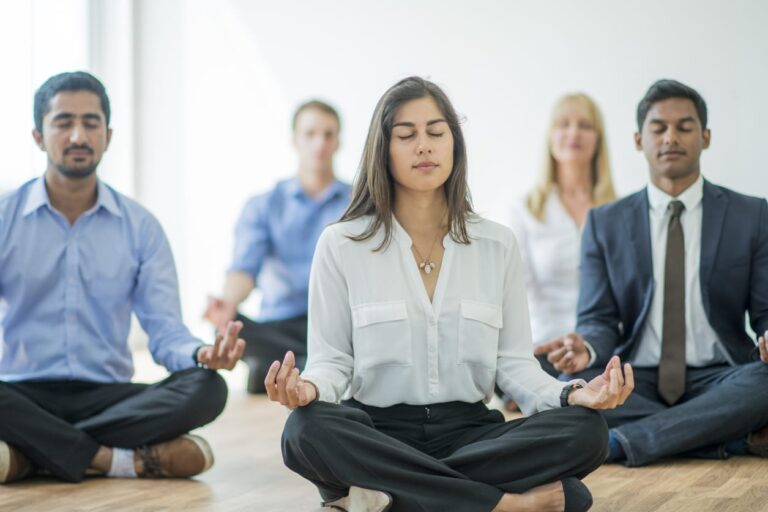
Mindfulness involves paying attention to all your thoughts, feelings, and sensations without judgment—an approach that can help ease anxiety and unclutter your mind. To practice mindfulness, find a quiet space where you can sit or lie comfortably and close your eyes while focusing on breathing. When your focus wanders, gently bring it back to breathing.
1. Breathing Exercises
Breathing exercises are an easy, stress-reducing mindfulness practice that can quickly soothe both body and mind. Try counting breaths to tune into their rhythmic inhale/exhale cycle to quiet racing thoughts and bring calm.
Utilizing this exercise, you can also practice sitting with any difficult emotions that surface and staying with them without judgment or forcing. Being mindfully present with anxiety, fear, anger, sadness, and other difficult feelings will allow them to dissipate over time. Other mindful breathing techniques include walking meditation and humming bee breath, both of which can easily improve mental clarity at any time of the day or night.
2. Body Scan
Body scans are another mindfulness meditation technique that can help alleviate stress and anxiety. To conduct body scanning, begin from either the top of your head or toes and slowly shift awareness through each part of your body, noticing any sensations such as tingling, itching, tension, or relaxation that arise without judgment or bias.
Body scanning meditation can be done either solo, or you can follow along with guided body scan meditation with voice-over narration to keep you focused and ensure you remain mindful. There are apps, videos, and classes available that provide this type of program; a 2021 study reported significant reduction in stress and anxiety levels after practicing body scanning meditation.
3. Mindful Observation
One of the core skills of mindfulness is observing our thoughts and emotions. The aim is to create space between ourselves and our experiences so we can respond consciously rather than reactively. Recognizing your environment—sights, sounds, and odors—will help to bring you into the present moment and reduce racing thoughts that lead to anxiety.
Practice paying attention to physical sensations, like pain and discomfort, in order to break the cycle of fear and tension. One effective technique for doing so is body scan meditation: you focus on breathing while noting any warmth or tingling sensations you detect during this practice.
4. Visualization
Visualization is an effective mindfulness technique to combat anxiety. The technique involves creating peaceful images in your mind that relax you. Immerse yourself in your scene of choice by engaging all five senses. Focus on sounds, smells, sights, and textures to fully immerse yourself in them.
You can practice visualization techniques independently or through guided meditations available on YouTube or meditation apps. However, if your anxiety is severe, it’s advisable to speak to a health care professional about treatment options; they will diagnose your condition and advise the best course of action for you.
5. Relaxation Exercises
Many individuals experience feelings of fear, worry, and anxiety. Utilizing mindfulness techniques like breathing exercises and grounding exercises to reduce anxiety may be effective solutions. Breathing techniques like square breathing can facilitate deeper, more controlled breaths during times of anxiety or panic attacks, helping individuals regain control and restore peace of mind.
Visualization and progressive muscle relaxation are also great relaxation exercises to try. Visualizing relaxing places such as beaches or forests can help lower stress hormones, while progressive muscle relaxation involves gradually tightening each part of your body and then relaxing it one at a time until tension has been released from every area.
6. Journaling
Writing down thoughts and emotions can help clear your head of clutter. Additionally, it can provide a way for processing difficult experiences as well as understanding cause-and-effect relationships. Begin by setting a timer for five minutes and writing down everything that bothers you. At the end of this period, reread your list to identify areas for change or resolution.
Journaling can be used as either an individual or guided journal, such as Calm’s Feelings Journal, to manage anxiety. Just keep in mind that it should only be seen as one part of an overall plan to address mental health concerns, such as therapy or mindfulness exercises.
7. Guided Meditation
Guided meditation is a mindfulness technique in which a narrator guides you through exercises designed to promote self-reflection and calm. You can practice guided meditation in any setting—be it a quiet room or while walking, commuting, or eating, for example.
Practice mindfulness to recognize ruminative thoughts and emotions without judgment, and accept them without judgment. This can be particularly liberating when realizing anxiety is completely normal and doesn’t indicate anything is amiss with you.
Guided meditations may involve breathing exercises or visualization techniques that encourage you to imagine peaceful settings like beaches and forests. Progressive relaxation may also involve tensing and relaxing muscle groups over time.
8. Mindfulness Exercises for Children
Similar to adults, children can gain from engaging in mindfulness exercises. Beginner meditation sessions should begin slowly before gradually expanding as children become more comfortable. Students can practice being aware of their heartbeat as a physical reminder to remain calm and grounded before shifting focus onto other sensations in their bodies, such as how their feet strike the ground when walking or running or the sensations associated with stretching a particular muscle group.
Mindfulness techniques can also be an effective way of helping those experiencing anxiety to identify its source while simultaneously staying with difficult feelings without judgment or the urge to alter them—breaking the cycle that creates stress and anxiety.
9. Mindfulness Exercises for Teens
Meditation practice can help people of all ages manage their emotions and feelings in healthy ways, staying present in each moment while tuning out distracting thoughts. Mindfulness may prove particularly useful for teenagers coping with school, social life, and family concerns that cause anxiety and stress.
Mindfulness exercises are practiced individually or collectively, with many families adopting mindful practices into daily routines, such as using the 20-20 rule when reading or working on devices to reduce eye strain or practicing breathing and body scan meditation together.